


What Business Process Should You Automate First? A Practical Framework
When a business decides to automate, the first question is often about technology.
Which tool should we use? Should we use AI? Should we connect our existing systems? Do we need custom software? Those questions matter, but they come later.
The more important first question is:
Which business process is actually worth automating first?
Choosing the right process can produce an early, visible improvement and build confidence for further automation. Choosing the wrong one can consume time and budget while delivering little practical value.
A good first automation is usually not the biggest or most impressive process in the organization. It is often a repetitive, stable workflow that quietly consumes time every day and has a clear outcome.
Current guidance on automation prioritization consistently points to factors such as frequency, repeatability, clear rules, accessible information, manageable exceptions, ownership, and measurable outcomes.
Start with the process, not the technology
A common mistake is to begin with a tool and then search for something to automate with it.
For example:
A company buys an automation platform and starts looking for tasks it can handle.
A team decides it wants to use AI before identifying the operational problem.
Management selects a large process because it appears strategically important.
A department automates one small task without considering what happens before or after it.
This can create isolated automation rather than meaningful operational improvement.
Instead, begin by understanding the work itself.
Before considering any technology, ask:
What starts this process?
Who is involved?
What information is required?
What steps are repeated?
Where do delays or errors happen?
What decisions require human judgment?
What is the expected final outcome?
If those answers are unclear, the process may need to be understood or redesigned before it is automated.
Automation should improve a process you understand. It should not be used to hide a process you do not understand.
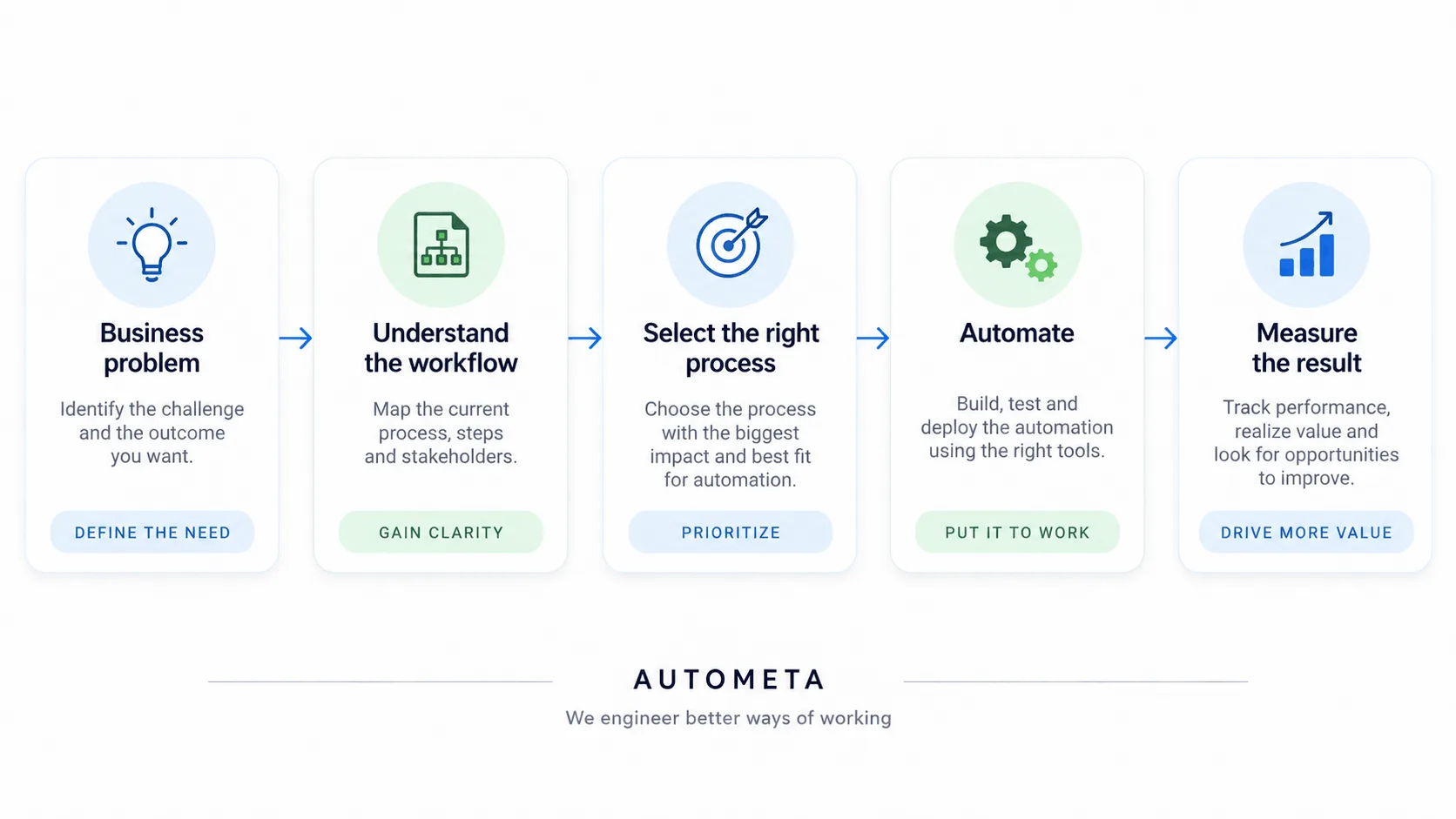
Six signs that a process may be a strong automation candidate
There is no single formula that works for every organization, but strong automation candidates usually share several characteristics.
1. It happens frequently
Small amounts of repeated work can become expensive when they happen every day.
Consider a task that takes only five minutes. If it is performed by several people dozens of times each week, the total effort can become significant.
Frequent processes also make it easier to see whether automation is producing a real improvement.
Good candidates may include:
Repeated data entry
Routine approval routing
Status notifications
Document collection
Recurring report preparation
Request assignment
Standard follow-up messages
Moving information between systems
Frequency alone does not make a process suitable, but it increases the potential value of improving it.
2. The normal workflow is reasonably consistent
Automation works best when the usual path through a process can be described clearly.
That does not mean every case must be identical.
Most real processes have exceptions. The important question is whether there is a recognizable normal workflow and whether exceptions can be identified and handled separately.
For example, an approval process may normally follow:
Request submitted â manager reviews â finance checks â approval â requester notified
There may still be exceptions for large values or unusual requests. Those exceptions can remain visible and be sent to the right person.
A process where almost every case follows a different path is usually harder to automate effectively.
3. People spend time moving information rather than making decisions
One of the strongest signals is when employees act as the connection between systems.
For example, someone may:
Copy information from an email into a spreadsheet
Copy spreadsheet data into another application
Download a file from one system and upload it into another
Re-enter the same customer or project information in several places
Collect information manually before preparing a report
Send routine updates when a status changes
These activities may be necessary today, but they often add little judgment or business value.
When people are primarily transferring information between systems, there is usually a strong reason to investigate automation.
4. Delays or mistakes have a real operational cost
Not every inconvenience deserves an automation project.
A stronger candidate is a process where delays, missed steps, or errors create consequences.
That could mean:
Customers wait longer
Approvals delay purchasing or delivery
Management receives reports late
Staff repeatedly correct the same information
Important requests are missed
Teams spend time reconciling conflicting records
Compliance steps are difficult to verify
The greater the recurring operational impact, the more important the process becomes as an automation candidate.
5. The outcome can be measured
Before automating something, you should know what improvement would look like.
Depending on the process, useful measures might include:
Time required to complete the workflow
Number of manual steps
Number of errors or corrections
Number of overdue requests
Staff hours spent on repetitive work
Response time
Processing backlog
Cost per transaction
You do not need a complicated measurement system.
Even a simple baseline gives you something to compare against later.
Without a baseline, it becomes difficult to tell whether the automation actually improved the operation.
6. Someone clearly owns the process
Every automation needs a business owner.
This is the person or team responsible for the process itself, not necessarily the person building the automation.
The owner should be able to answer questions such as:
What should normally happen?
What counts as a successful outcome?
Which exceptions require attention?
Who is allowed to approve or change something?
What happens when the automation cannot continue?
Without ownership, problems can remain unresolved because nobody is responsible for deciding how the workflow should behave.
Current process-prioritization guidance repeatedly identifies clear ownership as an important readiness factor.
A simple framework for comparing processes
Most organizations have several processes that could potentially be automated.
Instead of choosing based on frustration alone, compare them using the same questions.
Score each candidate from 1 to 5 on the following areas:
Frequency
How often does the process happen?
A process that occurs hundreds of times each month may have more automation value than one that happens twice a year.
Manual effort
How much employee time is spent completing repetitive parts of the process?
Include not only the main task, but also checking, chasing, copying, updating, and correcting.
Process clarity
Can the normal steps, decisions, inputs, and outcomes be explained clearly?
A process with unclear rules may need redesign before automation.
Error and delay impact
What happens when the process is slow or incorrect?
Consider financial impact, customer impact, operational disruption, reporting issues, and compliance risk.
Data readiness
Is the required information already available in a usable digital form?
If the process depends on incomplete information, handwritten records, or inconsistent sources, some preparation may be required first.
Exception level
How often does the process require unusual judgment?
Known exceptions are manageable. A process where nearly every case is unique may be a poor first candidate.
Measurability
Can you tell whether the automation succeeded?
If there is no clear way to compare the before and after state, proving value will be difficult.
Ownership
Is there a person or team responsible for the process?
A strong owner makes decisions and helps resolve exceptions during implementation.
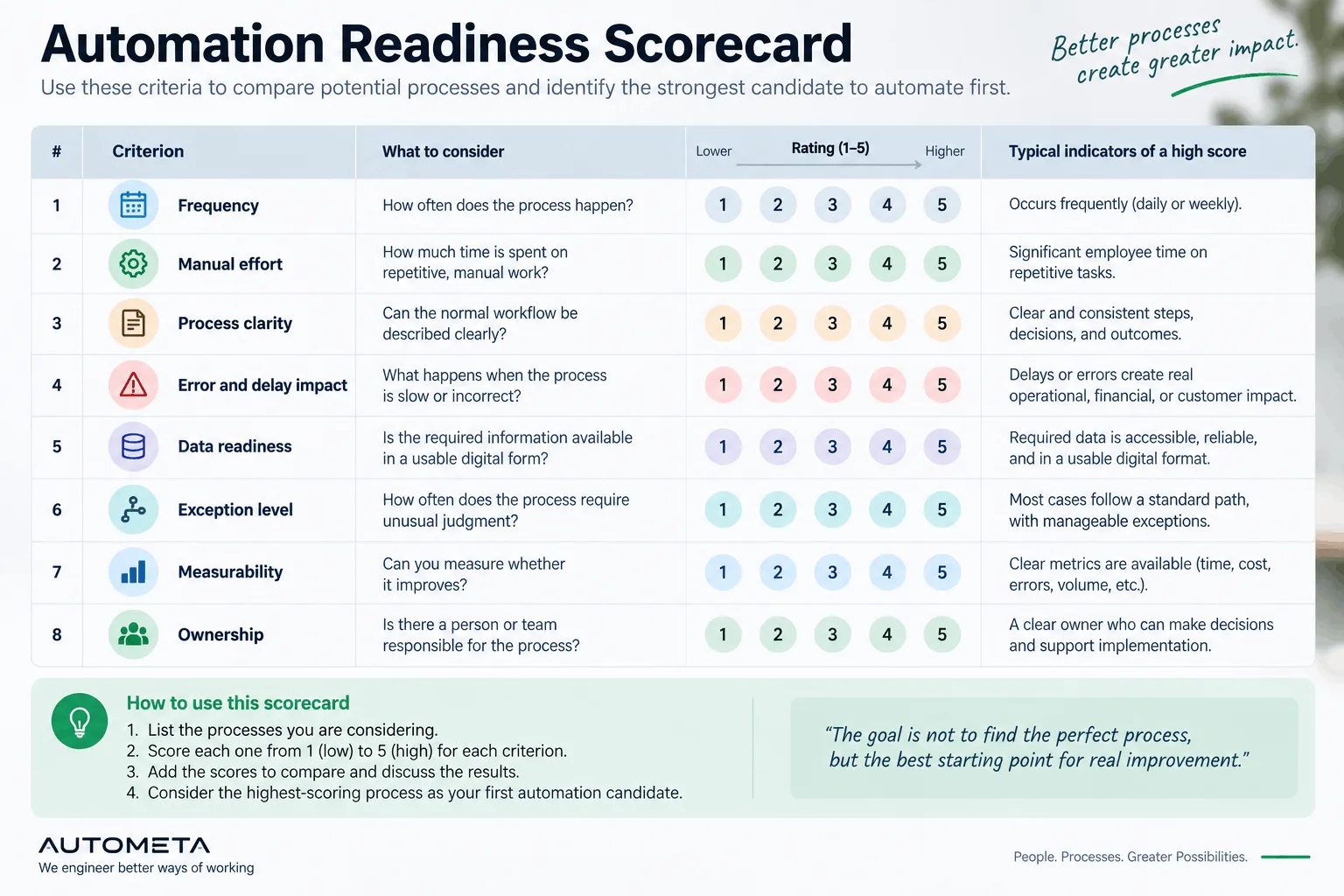
An example comparison
Imagine an organization is considering three processes.
Process A: Monthly management report preparation
It takes several days, requires information from different teams, and creates repeated reconciliation work. However, it only happens once each month and the reporting logic is still changing.
Process B: Purchase request approval
It happens many times each week. The approval path is mostly clear, requests are sometimes delayed, and employees regularly follow up manually.
Process C: Annual supplier review
It is important, but it happens once a year and involves significant management judgment.
Which should be automated first?
Process C is probably not the best first choice because it is infrequent and judgment-heavy.
Process A may eventually provide substantial value, but if the reporting process is still changing, automating it immediately may lock an unstable workflow into software.
Process B is likely the strongest first candidate because it is frequent, understandable, measurable, and has a clear operational effect.
The point is not that approval workflows should always come first.
The point is that automation priority should be based on process characteristics, not on how impressive the project sounds.
Do not automatically choose the most painful process
The process people complain about most is not necessarily the best first automation.
Sometimes a painful process is painful because:
The policy is unclear
Different teams follow different rules
Nobody owns the workflow
Required information is missing
The process changes frequently
Too many unnecessary steps have accumulated
Most cases require individual judgment
In these situations, automation may make the problem faster without making it better.
First ask whether the process itself should be simplified, standardized, or redesigned.
Once the workflow is clearer, automation becomes much easier to implement and maintain.
Several recent automation frameworks specifically warn against choosing a process simply because it is frustrating or technically possible to automate.
What should usually stay manual, at least initially?
Some work should remain human-led.
That is especially true when the process depends heavily on:
Sensitive judgment
Negotiation
Empathy
Strategic decisions
Unusual circumstances
High-consequence decisions with unclear rules
Rapidly changing policies
Automation can still support these activities.
For example, a system might gather information, prepare a summary, notify the right person, or record the final decision while leaving the judgment itself to a human.
The goal is not to remove people from every process.
The goal is to remove unnecessary manual work while keeping human involvement where it adds value or responsibility.
Look beyond individual tasks
Another common mistake is automating one task without looking at the larger workflow.
Suppose employees spend time copying information from a form into a spreadsheet.
Automating the copy-and-paste step may save time.
But the better question is:
Why does the information need to move through that spreadsheet at all?
Perhaps the complete process is:
Customer submits request â employee reviews request â information is entered into spreadsheet â manager approves â another employee enters the same information into a business system â customer receives an update
If you automate only one transfer, most of the manual workflow still remains.
Sometimes the stronger solution is to redesign how the entire process moves from beginning to end.
That is why process automation should be approached as an operational problem rather than a collection of isolated shortcuts.
Start small enough to learn
Your first automation does not need to transform the whole organization.
A controlled first project is often better.
Choose a clearly defined workflow where:
The boundaries are understandable
The volume is meaningful
The current performance can be measured
The risks are manageable
Users can provide feedback
The result can be evaluated relatively quickly
A successful first project gives the organization something more valuable than one automated workflow.
It creates practical knowledge about how automation should be designed, governed, supported, and expanded inside the organization.
Measure before and after
Before implementation, record how the current process performs.
You might measure:
Before automation
Average completion time
Number of manual steps
Monthly transaction volume
Number of errors or corrections
Number of follow-ups required
Staff time involved
Backlog or overdue cases
Then measure the same things after the new workflow has been operating long enough to provide a fair comparison.
Do not measure only whether the software runs.
Measure whether the operation improved.
An automation that works technically but makes the process harder for employees, creates new manual checks, or moves the bottleneck somewhere else is not necessarily successful.
Your first automation should create a foundation
The best first automation solves an immediate problem while also helping the organization learn how its processes, systems, data, and responsibilities fit together.
A useful first project should make the next automation easier, not create another isolated system that has to be maintained separately.
When evaluating candidates, look for a workflow that provides a practical improvement and helps establish better operational structure.
That may mean clearer ownership, cleaner information, better visibility, or stronger connections between existing systems.
A practical checklist
Before choosing your first process, ask:
Does this process happen often enough to matter?
Is a meaningful amount of time spent on repetitive work?
Can we clearly describe how the normal process should work?
Are the main inputs and outputs known?
Can common exceptions be identified?
Do delays or mistakes create a real business problem?
Can we measure the current performance?
Is there a clear process owner?
Can we automate it without removing necessary human judgment?
Will improving this workflow make other operations easier later?
If the answer is yes to most of these questions, you probably have a strong automation candidate.
If several answers are unclear, that does not mean the process can never be automated.
It usually means there is some process work to do first.
The main principle
The first business process to automate is not necessarily the largest, most frustrating, or most technologically interesting one.
Look for a process that is frequent, repetitive, reasonably stable, measurable, clearly owned, and important enough that improving it creates visible operational value.
Understand the workflow first.
Simplify it where necessary.
Then decide what should be automated, what should remain under human control, and how success will be measured.
That approach gives automation a much better chance of becoming a real operational improvement rather than simply another piece of software.