
Project
Healthcare and Mental Health
Psychiatry Diagnosis Support System
Client
A private healthcare client developing a structured psychiatric differential diagnosis and clinical reasoning system for psychiatrists.
Organization type
Private Client
01 / Challenge
The operational problem
Differential diagnosis in psychiatry is a careful, step-by-step process. A psychiatrist must begin with the patient's presenting problems, gather information without making early assumptions, identify meaningful clinical signs and symptoms, explore the right diagnostic pathways, and gradually narrow the possibilities into a list of candidate disorders. The challenge was to make this full differential diagnosis process work inside a software system. The software needed to support the natural flow of clinical reasoning without jumping directly to a diagnosis. It had to help the psychiatrist move from ordinary patient descriptions to relevant clinical findings, follow the appropriate differential pathways, consider more than one possibility when needed, and build a structured list of candidate disorders for further evaluation. At the same time, the psychiatrist had to remain in control of every important clinical decision throughout the process.
02 / Process
How we approached the work
The process starts with the patient's presenting problems and supports the psychiatrist in gathering information through neutral, open-ended questioning. The collected information is then organized into clinically meaningful signs, symptoms, and other relevant findings.
From there, the psychiatrist can select the appropriate differential pathways based on what has been identified. The software guides the reasoning process through those pathways and brings together the possible disorders that remain relevant.
The workflow was designed so that multiple clinical findings and multiple possible disorders can be considered at the same time, while the psychiatrist remains responsible for reviewing and confirming each important step.
03 / Solution
What we built
The Question Generation Engine helps the psychiatrist explore the patient’s presenting problems through relevant, open-ended, and diagnosis-neutral questions.
The Phenomenon Engine reviews the information gathered and helps identify the clinically meaningful signs, symptoms, and other findings that should be considered in the case.
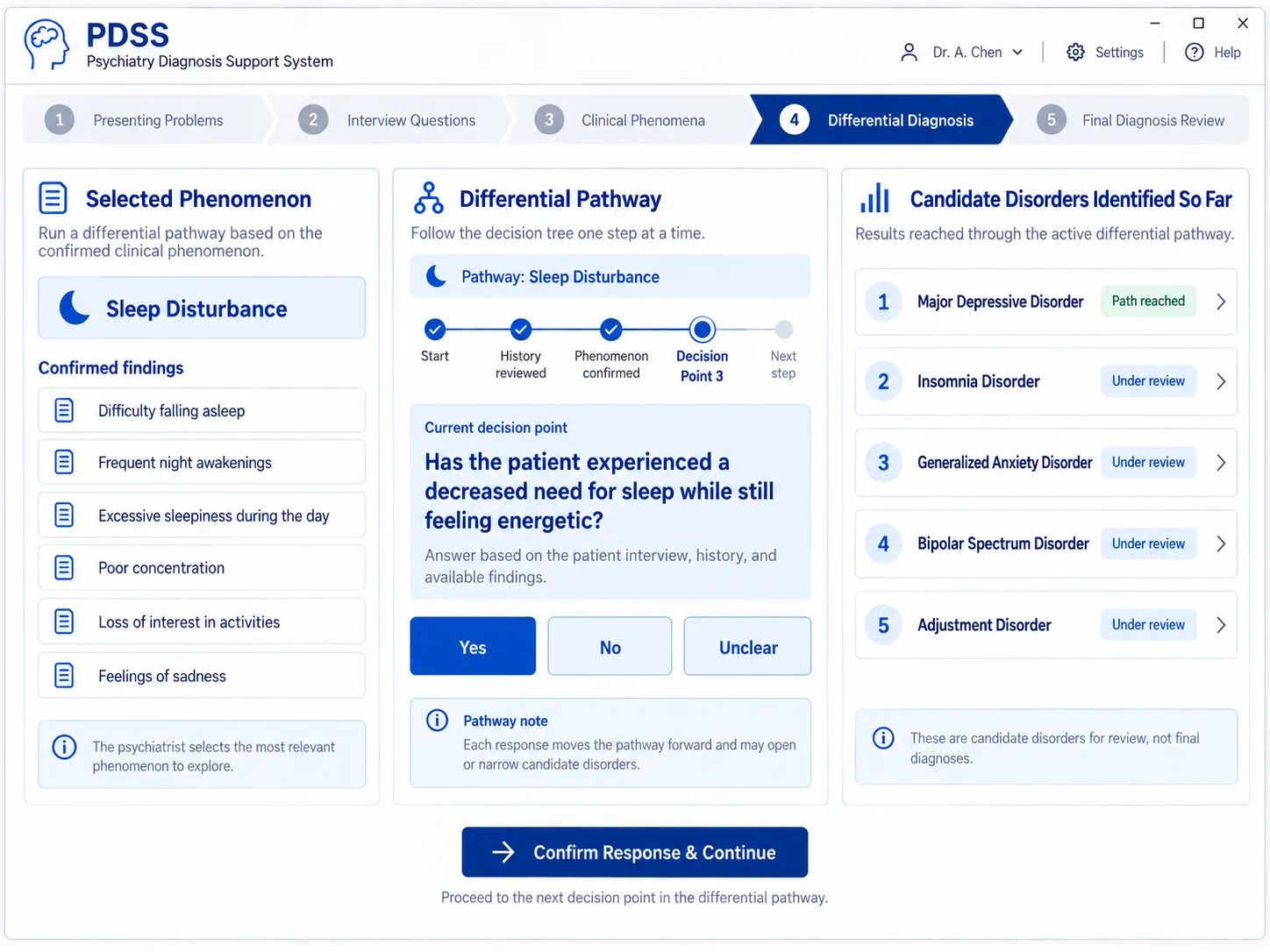
The Differential Diagnosis Engine uses those findings to guide the psychiatrist through the appropriate differential pathways, helping narrow the possibilities and build a structured list of candidate disorders.
The Final Diagnosis Engine then supports the review of those candidates against the relevant diagnostic requirements and exclusions, helping the psychiatrist move toward confirmation, exclusion, or further clinical evaluation.
Together, these engines implement the full diagnostic reasoning process inside one connected workflow, from the patient’s first presentation through differential diagnosis and toward final clinical decision-making, while keeping the psychiatrist in control throughout.
Technology
Technologies used
- ISO C99
- C# / .NET
- MISRA C:2023
- P/Invoke
- CMake
04 / Outcomes
What changed
The system brings together guided question generation, identification of clinically meaningful phenomena, differential diagnosis, and final diagnostic review in a structured sequence.
Psychiatrists can move from a patient’s presenting problems to a clearer clinical picture, explore the relevant differential pathways, build and review candidate disorders, and continue toward diagnostic confirmation or exclusion without losing the connection between each stage.
Because the four engines work together, information gathered early in the assessment can continue to support the later stages of reasoning rather than being handled as separate, disconnected tasks.
The result is a practical diagnostic support system that makes complex psychiatric differential diagnosis more structured, traceable, and manageable while keeping the psychiatrist responsible for the final clinical judgment.
Your operation
Have an operational problem that needs a better system?
Show us how the work happens today. We can help identify where process redesign, automation, or a dedicated operational system could make it work better.